
raise the roof
How to feel more good feels


Hopeful Lila at The Confetti Project's Open Studios. Image by Jelena Aleksich. June 2018
A couple of years back, I had this unfamiliar, tip-of-the-tongue emotion. Like an aroma from my childhood I couldn’t quite place. A dream smell, maybe. The way Brazil smells just outside of Guarulhos airport. The first time I opened a car door and stepped outside in Nevada.
It was 2008. My very first cross-country road trip. We stopped on the shoulder of the highway to pee. (I know, I know, inadvisable.) As soon as I stepped out, I smelled this … sweetness on the air.
It arrested me.
I didn’t know exactly what it was — but it seemed as though I almost did, even though I was sure I’d never smelled it before. I stood still and I breathed it in.
“That’s delightful!” I said. “That’s delicious! What is it?”
It turned out to be sage. Sage growing lush and rampant on the side of the highway. Flourishing and wild and un-tended. Have you smelled it?
***
The unfamiliar familiar feeling … it had a quality of pause that felt like the sage. It arrested my momentum. It was such a faint slow rhythm that I had to physically stop myself still, in order to discern what I was feeling. Then I had to get quiet enough on the inside to listen to the tender bird of an answer.
The answer was: contentment.
Holy shit, contentment?! Really? What do I do? How do I keep it?!
I’m reminded of the Nathaniel Hawthorne quote: “Happiness is like a butterfly which, when pursued, is always beyond our grasp, but, if you will sit down quietly, may alight upon you.”
Dude it’s a butterfly! Don’t. Fucking. Move.
I got off the subway. Don’t fall down the stairs, my brain said. Don’t. Fall down. The stairs.
There it is. The Upper Limits problem.
***
The upper limits problem is a concept I learned from the book Conscious Loving. I tell people about this book. I recommend it to everyone. I buy it for friends. And of the entire book, the part I continue to re-read are the passages about the upper limits.
The premise of the upper limits problem is this: at some point during our childhood, usually without realizing it, we made a decision about how good we are allowed to feel. We associated feeling good with, pretty much immediately, feeling bad. We were jumping for joy and babbling exuberantly and got told to keep it down; we brought home good grades and were told not to brag, etc. So at this point, most of us (not all of us, but honestly, probably the vast majority of us) created our own personal glass ceiling.
In the book, Kathleen and Gay Hendricks put it this way: “Starting in childhood, most of us seem to put a lid on our positive energy in order to stay at the humdrum level of existence necessary to function in the workaday world.”
My upper limit is much lower than I’d like it to be. (Still!)
This is why I have buyer’s remorse. This is why I triage without even noticing I’m doing it.
***
Surely, you know an Eeyore.
Someone who seems to have a permanent cartoon raincloud that follows them around, and rains only on them? I have an ex like that. He was one such Eeyore. He had one such raincloud. He, effectively, had no upper limit — in the sense that his upper limit was so low that any morsel of positivity triggered a backlash. He was constantly worrying about money, injuring his body in small ways, burning his tongue on food (and squealing), complaining about said burning of tongue, whining about, well, everything, and pretty much consistently annoying everyone around him with his lack of volume control and his anxiety and his litany of poor-me’s. He didn’t see how he was contributing to his own raincloud.
He really think his raincloud had anything to do with him.
***
One Valentine’s day, we had a fight after a night of dancing. We were hardly having sex anymore, and I was frustrated (and, truth be told, probably also hangry). Two young dancers were waiting for us to give them a ride home, but this fight had to be had. It had to be had. And so we had it there, in the parking lot.
“It doesn’t really put me in the mood when you get upset about it,” he said. “Maybe if you tried a different tactic.”
(That was a point well-taken. The only one I recall. The rest was bullshit.)
After we dropped the girls off, I asked him from the passenger seat, “Have you ever gone to therapy?”
“No,” he said.
“Don’t you think, it might be a good idea to go?” I nudged.
“Absolutely not!” he said.
“Why?” I implored, slightly scandalized.
“Because I don’t need it,” he said.
Then I was thoroughly scandalized.
Perhaps I chose him because his upper limit was even lower than mine. So I could feel superior. So I could be the one in the relationship who found joy easier to come by.
After I broke up with him, he chased me. Showed up to my yoga classes with flowers. Gave me handwritten love poems. (He’d been writing them for months, but didn’t show them to me until after I broke up with him.) Told me he bought me a car for my birthday. He was waiting to give it to me. He waited for months, and all the while I rode my bike to work in torrential Portland rain. My birthday was still months away when he told me. He showed me a picture of it, a little boxy red number. It was beautiful. I was so….. soggy. I never got a car.
He also took to stopping by my apartment.
One time, when the breakup was still fresh, he stopped by and I didn’t want to invite him in, so I went outside and sat with him in his car. He was shaking, feverish, his voice was cracking. He said there was something he wanted to tell me. It felt grave. And I had an inkling of what it was. It was something he had never told anybody before. It was the reason his upper limit was so low.
I held him from the passenger seat.
***
In Conscious Loving, the authors describe a typical upper limit pattern in relationships.
have fun/have a crash
get close/get sick
be close/start a fight
When I thought back on my few romantic relationships, this pattern was obvious in every single one. In fact, immediately after beginning a new relationship, right at the crest of my initial wave of infatuation, I’d usually get a cold. A bedridden, useless to the world, achy, sniffly, pathetic cold. Just when I was feeling so great! Just when my body was giving me the good drugs! Dopamine, oxytocin, limerence, come on!
The upper limits problem isn’t relegated to romantic relationships, though that might be where it’s easiest to spot. The Hendricks’ also note that most of us cannot spend more than a few minutes of feeling good with ourselves before needing to somehow bring our energy down to a more manageable level of goodness.
This is surely true for me. I hardly ever experienced bliss for more than a few moments at a time, without having a distracting thought, a worry, or stubbing my toes.
I realized that, years after I unconsciously created my upper limit — which I naturally do not remember — I consciously reinforced it. Sometime around high school or college, I adopted a kind of checks and balances theory about my life.
I imagined life as a Trivial Pursuit pie.
In the game of Trivial Pursuit, each person tries to win by getting all of the slices of the pie. The game piece looks like a colorful wheel of cheese. Each slice of the pie corresponds to a different category. Blue for Geography, pink for Entertainment, yellow for History, purple for Arts & Literature, green for Science & Nature, and orange for Sports & Leisure.
I imagined the Trivial Pursuit pie of my life to consist of work / family / friendships / romance / hobbies / spirituality / and art. If one aspect was going very well (I got a great part in a play), then another had to be going poorly (fight with my mom). In fact, as soon as something started to go well, I expected another shoe to drop immediately. I only wondered just which area of my life it would drop in. I accepted this as the human lot. Not everything can be good at once. That’s just the way it goes.
And then someone said to me, “No, Lila, it can all be good.”
It can all be good? All at the same time? No. Really?
No....
Really?
Short of enlightenment, I am still not certain about this, but I do believe that many things can be wonderful at once. But being able to feel them, that’s a different story.
(A Happy Dance helps. See: tiny wins essay.)
The Hendricks’ suggest that the best way to learn to tolerate more positive energy ... is to rest. Take a nap, take a break, go to the bathroom, walk around the block, cut the date short, go meditate, go to bed early. This fascinated me. I had never considered positive energy to be something I had to learn to tolerate. And that I could. I could learn to tolerate it better. I could learn to tolerate positivity in service of my wellbeing, in the same way that I could learn to cope with discomfort. By training it. As a skill.
The Hendricks’ propose a new pattern: positive/rest, positive/rest, positive/rest.
I hereby declare that “rest-positive” is now a thing.
Let us cultivate rest-positivity!
In that vein, here is a rest-positive guided meditation for you:
Rest-positive means rejecting the cult of busy, refusing to become indoctrinated by this bizarro-land puritanical office culture that has infiltrated every corner and crevice of our bloated society. It means we don’t try to fill each and every moment with productivity. We do not have to be doing things, or dare I say, accomplishing things, all the damn time. Constant productivity exists nowhere in nature, so why do we expect it to exist in us?
We too are nature, are we not?
Rest-positive means we give ourselves time to integrate anything we’ve just experienced. This is why my yoga teacher training insisted we instruct our students to take Corpse pose at the end of class for a minimum of five minutes, and why yoga teachers often spout that Savasana is “the most important pose.” One of my students called it The Gift. Having a rest pose conclude our practice gives us the chance to integrate the experience we’ve just had. It forms a bridge between revelation and the subway.
Rest can be just about anything restful. The only requirement is that the activity (or lack thereof) is restful to you. One person’s rest is not another’s. Something that grounds you might unseat me. Meditation makes her calm; it makes him anxious. Etc.
“Part of the Upper Limits Problem is that your physical boundaries are transcended. Part of being loving to yourself is to find ways of coming back to the ground again without unpleasant side effects. Falling down is an unloving way to get yourself grounded, while taking a walk is much more kindly.” - Gay & Kathleen Hendricks
The Hows now. How do you know when you need to rest? How do you know when you are about to hit your upper limit?
If I am very, very attentive to the sensations in my body, I can usually catch it in time. In Conscious Loving, they talk about it feeling ashy. That the quality of approaching an upper limit feels grey and powdery and desiccated. Dull. The opposite of juicy. My former housemate said he could identify it as the point when the pleasure doesn't get inside him, but sort of glances off the surface of his skin and slides away.
It could feel like you're watching a movie and the image changes from color to black and white. Or as though your brain is aware that you're eating something delicious, but you can't taste it anymore. Or a nibbling feeling that you’d rather not be here now, even if you were enjoying it immensely a moment before. This isn’t fun anymore. I want to go home.
For me, it can feel like the day before I get a cold, an underlying hum of impending exhaustion, a weariness, a malaise.
If I am able to catch the sensation in time, before I pick the fight, have the accident, or get the sniffles, I can practice that most effective technique for raising my upper limit. I can rest.
Again, how, Lila, how in the world do you rest anyway?
As I am wont to do, I have made you a list. Here are a few of the ways you might rest:
the actual nap
20 minutes or an hour and a half, so you’re not such a Grogmonster when you wake up
the meditation break
sit quiet. shut up. close eyes.
the “excuse me for a moment, I need to use the restroom” break
my favorite (also a great time to take a Bathroom Portrait)
the breather
going to aforementioned bathroom and taking 10 deep breaths has kept me from losing my shit on annoying persons multiple times, including! right before my final exam to become an AcroYoga teacher
the dance break
even 2-5 minutes would serve. bonus if it’s a favorite song.
the electronics/social media detox
{TURN OFF YOUR PHONE, LILA}
Better yet, turn off your phone and put it in the other room so you can’t even see it. For reasons.
the artist’s date
per The Artist’s Way, taking your inner artist on a solo expedition
the brisk walk around the block
for that matter, the slow saunter around the wherever
the run / jog / wog
ah, the walk-jog, the only way in which I “run”
the Do Not Disturb sign
close the door and make like a hotel room
the period of silence
“Could we please be quiet for 10 minutes?”
the restorative yoga session
my faaave
the nature walk / sprawl
yea yeah, bla blah, nature (nature)
the candle lighting
the Unitarian Universalists have a beautiful practice of lighting candles for joys and concerns, spoken or silent, depending on how you feel
the journaling
write it all out — freewriting is a wonderful way to chew up your experiences for better digestion
the spring clean
a la Mama Gena — here’s a video I made about spring cleaning … Often the spring cleaning exercise is used for venting purposes, but we can also vent about good stuff too! We can give our marvelous experiences words and voice and air and space to breathe, as a way to let them permeate us, meld into us, become us, and ultimately clear out space in our emotion morass to make room for even more goodness.
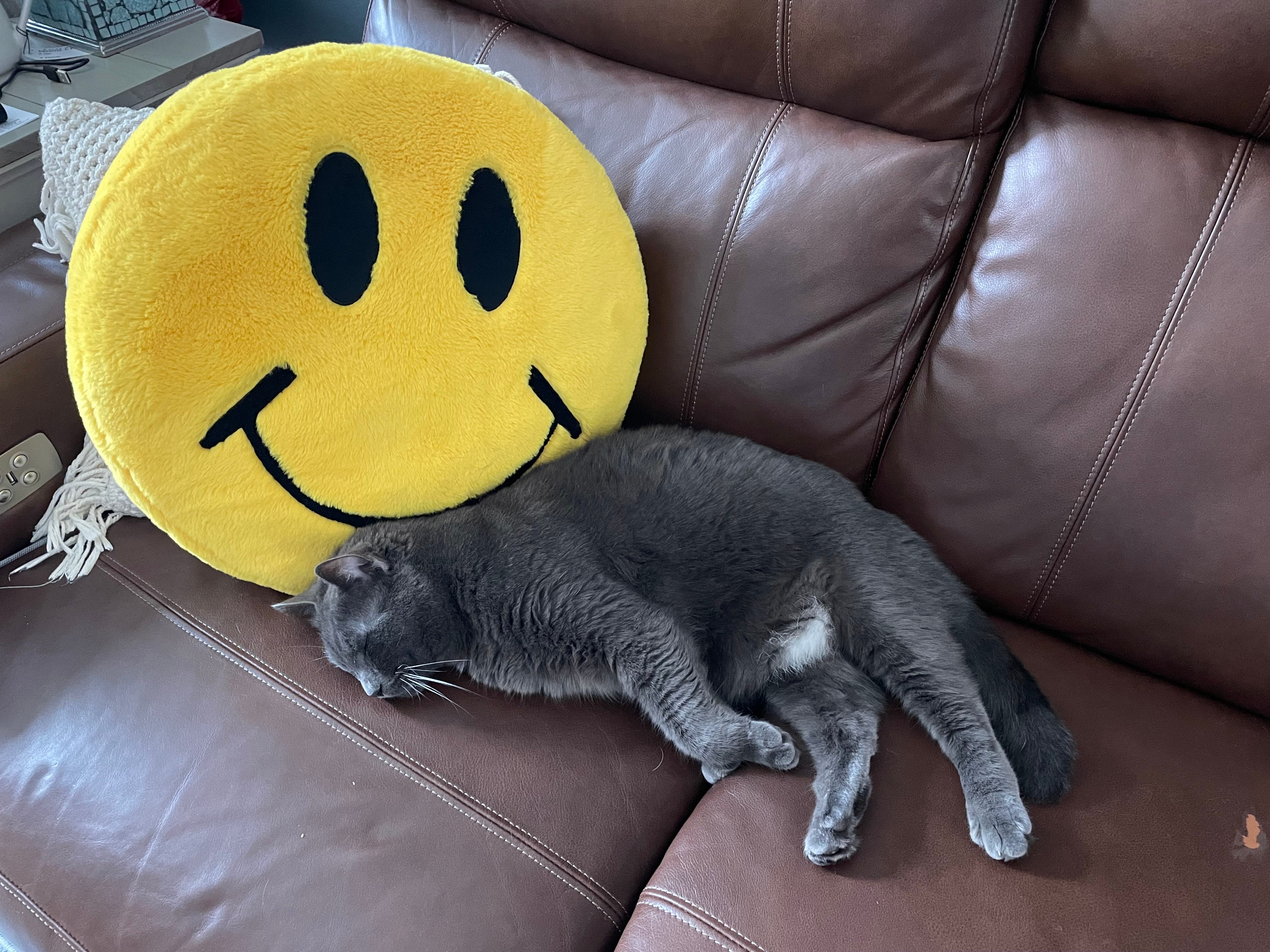
And/or, take a cue from cats! In this case, take your cue from Thumper, one of the illustrious felines cared for by Mr. Adam S Peters, here lookin’ like an unbothered shrimp/ 2025 / St. Petersburg, FL
I usually think of self-care as medicine for what ails me, or as routine maintenance, but never before I read Conscious Loving had I considered it a technique to increase my capacity for good juju.
I want that juju.
I want more goodness, more positivity, more joy, more good feelings! And I want to feel them for a longer period of time!
I mean. Don’t you?
Then rest, my pretty. Rest, and raise the roof.
I love that Thumper got a cameo in this one! Love to see you writing dear friend. This was lovely.